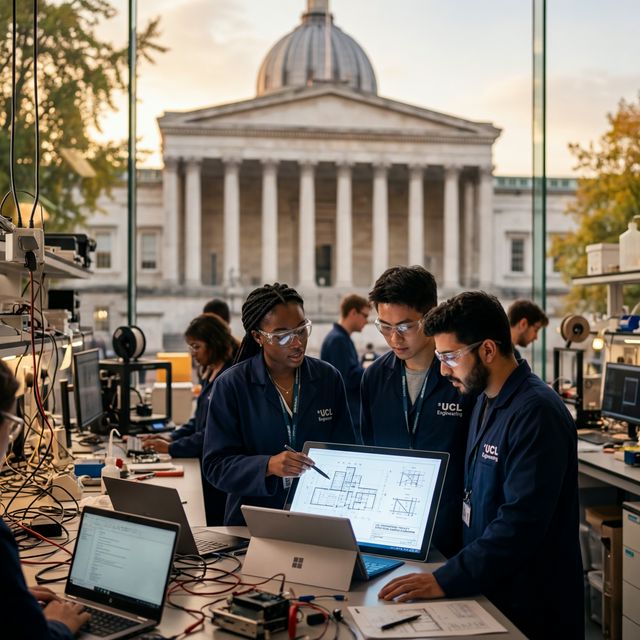
BEng Electronic and Electrical Engineering
About this course
Electronic and electrical engineering is the discipline that designs, analyses, and develops the systems that generate, process, and transmit electrical energy and signals. From power systems and renewable energy infrastructure through to microelectronics, telecommunications, robotics, and the embedded systems that control everything from medical devices to aircraft, this is a field of enormous scope and consistent economic importance. At University College London this three-year full-time programme gives you a rigorous training in the fundamentals of the discipline, covering electrical circuits, electronics, signal processing, digital systems, electromagnetics, power engineering, and control systems. You will develop strong mathematical and analytical skills alongside practical laboratory competence, learning to design and test circuits and systems, to use computer-aided design tools, and to tackle engineering problems with the systematic approach that professional practice requires. UCL's research-intensive environment means you will encounter cutting-edge work in areas such as photonics, communications, and power electronics alongside your foundational studies. UCL's London location and its world-class research facilities make it one of the most stimulating environments in which to study electronic and electrical engineering. The university's strong industry connections and reputation support excellent graduate outcomes. Graduates go on to careers in telecommunications, power engineering, semiconductor design, defence electronics, medical technology, renewable energy, consumer electronics, and control systems. UCL graduates are in demand from leading engineering companies, technology firms, and research organisations across the UK and internationally. Many also continue to postgraduate study in electronic engineering, communications, or related specialisms, and some pursue chartered engineer status.
Syllabus & Modules
Typical curriculumStudent Satisfaction
National Student Survey - 95 respondents (75% response rate)
Similarly Ranked Alternatives




What comes next? 🎓
Choosing the right university starts with choosing the right school. Explore transparent, data-driven school profiles powered by official DfE statistics.
Explore Schools on WhatSchool.ai →